The country is facing another serious flooding due to heavy rainfall that is worrying to many Kenyans but the new curriculum is as much as worrying to many parents especially in the rural areas.
Parents who are already faced with many financial difficulties again have to put their hands much deeper in their pockets just for their children to get a good inheritance since land has become scarce and farming the backbone of the country is infiltrated by cartel unpredictable weather due to climate change, they are only left with education as a clearer path for their children.
Most parents believe that if their children are educated, they will have a great future a concept that was installed in my mind when I was doing the 8-4-4.
The new curriculum is a major concern to many parents due to its cost.
John Kanampiu a Businessman who sells motorcycle spares in Kiriani market, Maara Constituency is a parent of pupil in PP2 said there is infrastructure challenge facing Competency Based Education.
Kanampiu a parent of a rural private school said there is shortage of classrooms and laboratories for Junior secondary school in most schools a great challenge for Competence Based Education.
“Like now we are holding a fund raiser to construct a laboratory. There is also shortage of trained Junior Secondary School (JSS)teachers or specialized teachers to handle Competency Based Education.
Kanampiu said the financial burden is much for a parent to educate their children as they are being asked for CBE books which keep on changing with time.
“When they go home for holidays, we are forced to buy holiday assignment books we are buying book each and every time it’s too costly for us as parents,” Kanampiu said.
He went on to say that CBE also burdens the teachers which means that with shortage of trained teachers in CBE and the increase in the numbers of subjects from the old 8-4-4 each some teachers can handle a total of 14 subjects.
“The teachers are forced to give many assignments to cover the syllabus meaning they pass the burden to parents who are not conversant with the CBE,” Kanampiu said.
He said with the 8-4-4 it was possible for a parent to help a pupil with assignment but with CBE it is difficult as the content is a bit different.
Kanampiu went ahead to say that most schools especially in the rural areas do not have technological advancement to ensure digital literacy.
“Some school even do not have electricity leave alone computers and parents will be forced to dig deep into their pockets to install solar systems or parents are forced to purchase smart phones and internet bundles for their children to catch up with others digitally,” he said
He said some of the learning materials go overboard and most parents cannot afford.
“There was a time the pupils in my school were asked to each bring a live chicken and cooking fat the slaughtered the chicken and cooked in school but they were not allowed to carry the remnants home,” Kanampiu said.
In sports Kanampiu said parents spent heavily on games kits and schools that do not have proper playgrounds and other amenities like swimming pools, basketball courts etc. parents are forced to cater logistics for them to be taken where the facilities are.
He said that parents again dig deep into their pockets on uniforms as one change uniform from preprimary, junior school and senior school.
According to Kanampiu the cost of educating purchasing learning materials for a pupil in preprimary and junior school exceeds that of senior secondary fees for a day school.
He said although the CBE may be good to the children in future the cost now is unbearable for many Kenyans who are struggling financially due to high cost of living urging the government to intervene and streamline the CBE to make it more affordable.
About Fivety kilometers away in Meru town North Imenti constituency we meet Janerosa Gacheri a Grandparent who has two grandchildren in Grade 1 and Grade 5 that she is educating. She said the CBC is very costly especially to grandparents like her who are educating children on behalf of their children. She said that she is forced to spent about Sh.30,000 per term for the two grandchildren for learning materials and books alone.
“We are being asked to buy things like cooking rice, chicken games kits and many other food stuffs and learning materials,” Gacheri said.
She pointed out subjects like home science that she said a lot of learning materials are required to be used in sewing and other practical.
Gacheri said pupils who fail to go with the learning materials are not allowed to attend school.
Gacheri said most pupils in public schools’ parents still take maize and beans and other food stuffs for their children so that they can eat lunch and other meals in schools.
Gacheri said those in rural set up where money is scarcer are the hardest burdened by the CBE.
She urged the government to speed up the restructuring of CBE to make sure it is less costly to parents and guardians.
A cyber operator Mutuma M’anjuri in Meru town said that there has not been a lot of printing of assignments as they had anticipated.
“We had hoped that we would be making a lot of money when the CBC was launched but it is not the case,” M’anjuri said.
He said the cost per parent is not above Sh.100 especially in creative arts, usually parents complain a lot of the cost since many say they are struggling financially.
“There was no enough public participation about the implementation so as a parent it is not helping me as my child is not often asked for books,” M’anjuri said.
He also urged the government to review CBC and make necessary amendments to ease the burden of parents.
Purity Nkonge the chief principal Yururu girls’ comprehensive school has called on the government to provide addition learning materials to grade 10 learners to support effective implementation of new curriculum. He spoke during a grade 10 parent orientation meeting at the school. She said there is need for the government to allow more publishers to produce learning materials.
Maureen Kagwiria a head teacher in charge of KAN Academy in Nchiru, Tigania West constituency a private school said the CBE is stretching parents and institution themselves.
“As private school’s parents have to buy Books and other learning materials by ourselves which keep changing frequently and if KICD changes their curriculum you have to change the books and the old books become useless,” Kagwiria said.

Kagwiria said the change of books maker many private school loose value for their money within a short period.
“In private schools we do not offer books to pupils’ parents have to buy so when parents who are already struggling to pay fee buys a book and that book is used for only one term it becomes a loss to parents,” Kagwiria said.
Kagwiria urged KICD to have one book per subject to avoid straining parents financially.
“In rural areas where people live from hand to mouth and the purchase of other learning materials like Jembe, Colours, Fork which are only used once it is financially draining,” Kagwiria said.
On infrastructure Kagwiria said the due to lack of enough time for transition from 8-4-4 to CBE the schools especially private did not have the ability to provide learners with of Junior Secondary School (JSS) with computer labs, laboratories it is a big challenge to not only learners but the teachers.
“You can imagine teaching a practical lesson theoretically it is very dissatisfying we adapted to the system yes but such things might be a great challenge,” Kagwiria said.
On the teachers being trained on CBE she said all teachers cannot be trained on the curriculum but their managers can organize for them to attend workshops and get appraisals.
She however lauded the CBE for nurturing talent from a young age which the 8-4-4 lacked.
“For instance, a child can identify themselves as good in Volleyball it will be nurtured from as young as grade 1 and that is good because talent pays, it also introduces learners to the world early as they are taught life skills,” Kagwiria said.
Kagwiria said for the government to make CBE better it should give private funds to cushion the CBE as many private schools are the ones that are mostly affected as they lack proper infrastructure and learning materials.
“The government should also stop leaving out the private sector when they are training and sensitizing teacher on CBE, we are also teaching Kenya pupils and they all belong to Kenya,” Kagwiria said.
Kiambi Atheru a former county secretary with the county government of Meru who owns KAN group of Schools said that most private schools have collapsed under CBC.
Atheru said the CBC is better than the previous curriculum but government did not do enough public participation and as a result they hurt investors who had put up private schools.
“Private investors were not considered it’s like the government only looked at public schools for instance there were ECDE colleges for teachers that were closed across the country because of the abrupt change of curriculum,” Atheru said.
He said there is need for more reforms if CBC is to work accordingly.
“In 8-4-4 curriculum most parents wanted to take their children to private schools because of high performance, competition but with the new curriculum performance isn’t important and there is no ranking and this made the number of pupils to private schools to decreased and most private schools were closed,” Atheru said.
He said CBC does not have the undertone of competition and private schools were thriving on that.
“Although performance is still there but it is not with the same strength as it was before,” Atheru said.
He said that private schools have now been turned into day care for parents who do not want their kids at home unlike before when parents took their children to private schools for better performance.
Kenya National Union of Teachers (KNUT) Meru Branch executive secretary Caxton Miungi said that when CBC started it had many challenges as teachers trained on CBC were not enough and classes were not enough.
“As we talk now very many schools have got enough teachers desks, classrooms but very many schools are lacking laboratories to be used by Junior secondary Schools (JSS) pupils in grade 7, grade 8 grade 9,” Miungi said.
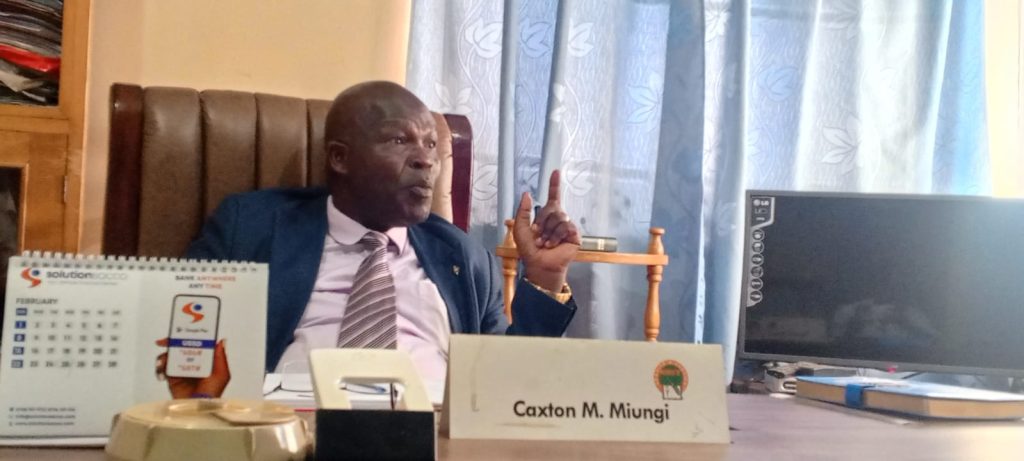
He said very many pupils are forced to rely on neighbouring senior Secondary schools.
Miungi said at the beginning there was a challenge with books but the ministry has been able to supply books and they are more than enough for learners.
Miungi disputed the notion that CBC is a burden to parents and said the exposure is needed for the learners to be able to do what is happening in the real world practically.
“Books can change with time depending on the publishers and also the syllabus from KICD but it keeps getting better each and every day,” Miungi said.
Miungi said that the change of books shows the publishers are doing their best to make the syllabus work.
“Different publishers write different books but syllabus is the same and it achieves that same objective.
Meru County Director of Education Joseph Ole Maki said the CBE is affordable as the government caters for everything.
“Actually, it is even free as the government buys books and there is enough book in all our schools, “Maki said.
He however said the government has no mandate to give books to private schools.
Maki acknowledged they have a problem with laboratories in some public schools.
“We improvise and use the nearby secondary school’s laboratories and equipment as most are near primary schools,” Maki said.
He spoke in his office, where he said they are training teachers on the CBE.
“We have already trained teachers for Junior secondary school and we are training for senior secondary school and Head of Departments for sciences and mathematics and technical areas, “Maki said.
North Imenti MP Rahim Dawood said 2023/2024 financial year they had put money for JSS Laboratories amounting to Sh.310 million that they were supposed to buy mobile laboratories so that whenever there are extra classes that required them, they can be used.
“They would store it in the administration block and then the move it to classes when they are doing lab work we had already got a quotation and put it in the budget but later we were told that the ministry of education would be providing those laboratories and we did not need to buy mobile labs and we had to reallocate the money to other projects,” Dawood said.
He said that they were then told by the government through the ministry of education will sort it out and that schools next to day schools or boarding secondary schools the JSS students would use the laboratories in those senior schools and for the last two financial years they have not allocated any money.
He said school which do not have the laboratories in his constituency can write minutes and petition his office so that he can do about it.
“unfortunately it has not been possible to have laboratories everywhere and when we do the public participation in schools and we are not given a priority project as a laboratory that is minuted we cannot give what is not asked for,” he said
The legislator said they are doing what they can to make CBE a success, he said they allowed in the NGCDF in the bursary kitty to use money for examinations and go for the test which we can pay for.
“We have already done public participation with head teacher and principals in the constituency and we are working out how we are going to accommodate that so that from next financial year we will cater for exams and those remedial and test papers,” Dawood said.
Erick Mutwiri an economist who previously worked with the county government of Meru and was fundamental in drafting proposals that were accepted by World Bank said that CBE is a good initiative and countries that are economically stable started with changing their education system.
“CBC is supposed to be competency based and around skills after stakeholder who were working to change it found 8-4-4 was competitive.
“In schools it was about doing well and being ranked highly and those who underwent 8-4-4 are very competitive,” Mutwiri said.
He said CBE is supposed to bring young Kenyans who are the future of the country however he said there are challenges despite it being a good initiative.
“We need to address the challenges and not to seek a need system which will be expensive, the government needed to first put good infrastructure but instead it rushed to implement it without putting good infrastructure,” he said.
Mutwiri said parents are the ones who are suffering as cost is passed down to them.
“For instance, there is need for printing and they are asked for other learning materials in school which burdens them because of hidden cost meaning the parent does not only pay fees therefore making the families poorer,” Mutwiri said.
Mutwiri said the government needs to add more money to the budget to make the CBE even more successful.
“Learners should not be told to come with learning materials from home it should be at school so teachers should have a good program so they can know what they require and forward to the government through ministry of education so that no learner is asked to bring any learning material from home,” Mutwiri said.
He said Laboratories need a multi sectoral approach to make sure no school lacks laboratories.
Mutwiri said that such shortcomings in CBE have made parents to lack confidence in the system.
“It has very good pathways for the learners such as sports pathway, art pathway which will help the creative and talent industry grow and create jobs,” Mutwiri said.
Mutwiri said the government should do necessary reforms as education is key to for the country transformation if at all Kenya wants to match Singapore.
“Singapore first made their education skill based so like in industrialization and manufacturing learners are taught about it when they a still very young age,” Mutwiri said.
He said first the country should first identify what kind of economy we want to focus on is it agricultural producer economy or may be industrialization so that CBE can be aligned and reflected with the workforce we want to produce as a country.
“Education sector should serve the economy we should not do the same mistake we did with 8-4-4 where we focused so much on education and let the tea and coffee sector collapse which were the economy backbone and the sectors where learners would go,” Mutwiri said.
He said there are only a few years to 2030 yet most of the projected goals have not been achieved.
“Everything is disjointed and it’s the responsibility of the government into first align with medium term plan to contribute to the vision 2030
He said that legislators should use the NGCDF to improve the system
Efforts to get comment a comment from Kenya Institute of Curriculum Development were futile when reached out through the number they put on their website they referred us to the CEO Professor Charles Ongondo where they asked us to email him, he will respond and after a period two weeks there was no response by the time of going to press.
Edited by John Majau