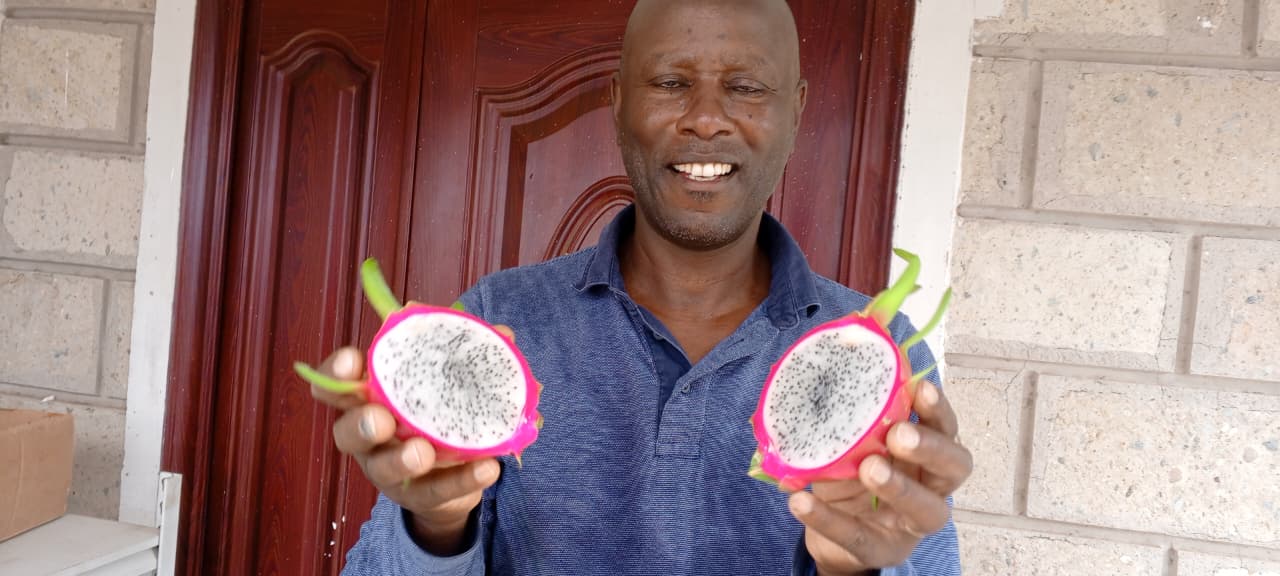
When Antony Kinoti Mugambi, a telecommunications engineer working in Nairobi, Kenya visited China on a work trip in 2012 he had no idea the visit will help him initiate own dragon fruit farm.
“Twenty three years ago, I visited Guangzhou China and ate a very interesting food item. I didn’t know if it was a plant, fruit, vegetable or a processed item. It was melting in my mouth like ice cream,” he said.
For a record nine years, the taste kept ringing in his mind until his second visit to the country.
“I observed Chinese were looking healthy and active. You could hardly differentiate the old from the young,” he narrated.
His Friend Alex Sundebao, a Chinese revealed to him the secret is simply that they ate food as medicine.
He narrated to him about Pak Choi, Durian, Mangosteen Tino, Dragon Fruit.
“The name Dragon Fruit caught my attention and made me curious because Dragon is a mythical creature. But he insisted it was a valuable fruit,” said the engineer.
Later they went to a supermarket, Sundebao picked an artificial looking item similar to a pineapple but its soft and very vividly picked cost, about 10 US Dollars.
That is when it dawned on him that it was the Dragon Fruit he had eaten in 2012.
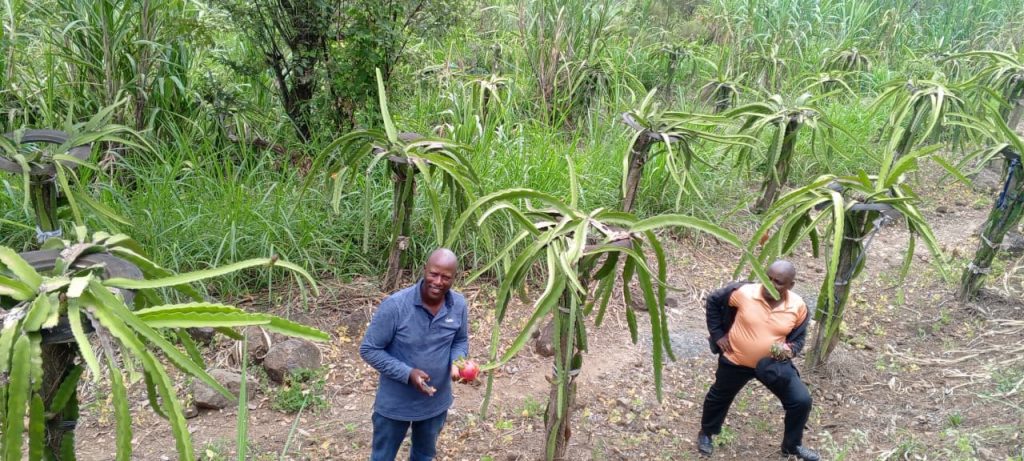
He then got some fruits extracted seeds brought back home, planted and patiently waited for eight years. On 28th April 2020 he got his first fruit.
It originated from South America where it is called Pitaya, a Cactus family plant.
He discovered that one can cross the wild cactus variety with a dragon fruit, create your own variety.
He did his own variety which took four years to get a government patent protection for 25 years.
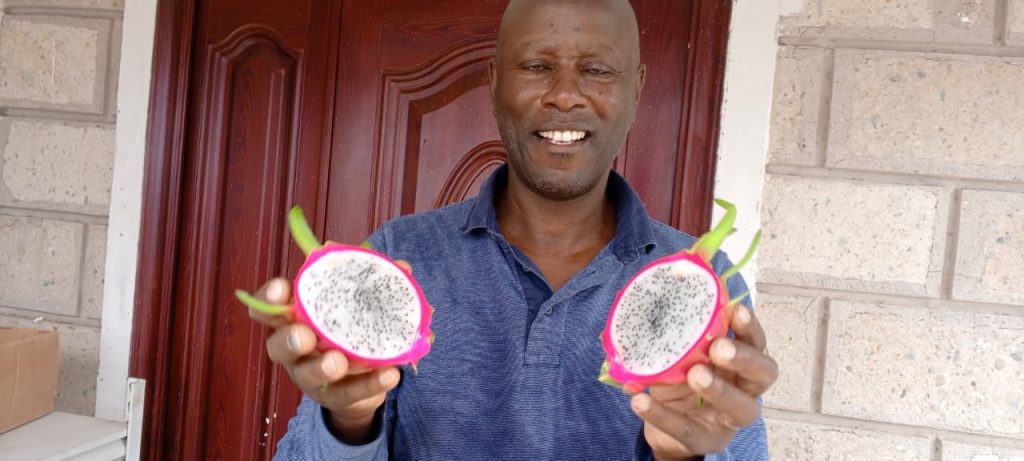
According to the law, Plant breeder rights protects any other entity benefiting from his intellectual property without his consent or authorization. As a pioneer Dragon Fruit Farmer in Kenya, he had nobody to learn from.
“For instance, it has varieties are self-infertile. You have to wake up at night, get pollen from another flower and pollinate them. It also flowers only one night in its entire existence period,” he said.
He said the seed takes eight to ten years to produce a fruit.
Mugambi has so far produced many mature stems which takes between 12 month -18 months.
He has urged farmers to diversify instead of relying on traditional cash crops noting semi-arid areas are suitable as it takes lesser time in warm areas than in cold areas.
After harvesting the first batch of fruits, he expanded his orchard and nursery although he hasn’t satisfied demand.
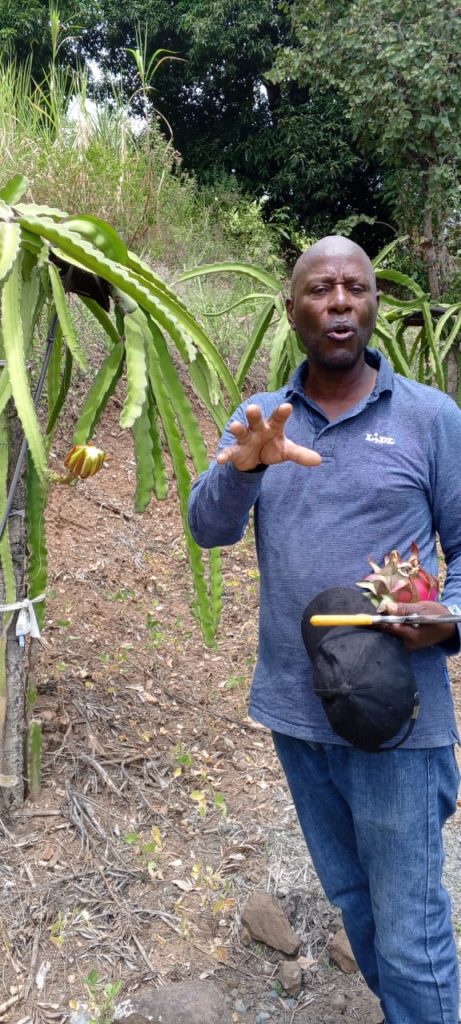
He has mentored over 1000 farmers in Africa. His first international guest was Emmanuel Okine from Ghana in 2021, has a successful Orchard in Ghana.
It’s expensive because of health benefit, nutritional value, pharmaceutical and cosmetics use. In Kenya a kilogram is about Sh1500.
It helps reduce hyper acidity or stomach acidity.
“For instance, if you consume pepper and then you are given dragon to chew, the pepper bitterness will go away in two minutes. Fruit fly damage dragon fruits by laying eggs inside the fruit then larvae forms. We mitigate by minimizing use of chemical pesticides. We recommend use of fruit fly traps that are Pheromone laced pesticide put in a container. They attract fruit flies in the container. They are then trapped and die inside,” saiod Mugambi.